
Why Prompt Engineering Is the Most Underrated Skill in AI Development
There is a persistent misconception in the engineering community that prompt engineering is not real engineering. The argument usually sounds something like: "It's just writing sentences. Anyone can do it. It will be automated away in six months." I want to challenge every part of that claim — because I think it reflects a fundamental misunderstanding of what prompt engineering actually is, and a costly underestimation of the leverage it provides.
As large language models become the new infrastructure of software — embedded in everything from IDEs to production pipelines — the ability to communicate with them precisely and reliably is no longer a soft skill. It is a core engineering competency. And right now, most engineers are doing it badly.
The Illusion of Simplicity
The reason prompt engineering is underestimated is the same reason it is undervalued in interviews and overlooked in engineering curricula: it looks easy from the outside. You type words into a box and get words back. What could be hard about that?
The same illusion applies to SQL. You type English-like sentences into a database and get rows back. But anyone who has spent time optimising query performance, reasoning about index selection, or debugging a subtle join condition knows that the apparent simplicity of SQL conceals significant depth. Prompt engineering is no different.
A naive prompt and a well-engineered prompt can produce outputs that differ not just in quality but in kind. The naive prompt produces something plausible-sounding. The well-engineered prompt produces something reliable, consistent, and verifiable — the difference between a prototype and a production system.
The Patterns That Separate Good from Great
Like any engineering discipline, prompt engineering has patterns — reusable techniques that reliably improve outcomes. Understanding them is the difference between treating an LLM like a magic eight-ball and treating it like a programmable system.
Few-shot prompting is among the most impactful. Rather than asking a model to perform a task in the abstract, you demonstrate the task with two or three examples before presenting the actual input. The model uses those examples to infer the pattern you want. This single technique can dramatically improve output consistency on classification, extraction, and formatting tasks — without any fine-tuning.
Chain-of-thought prompting is particularly effective for reasoning-heavy tasks. By instructing the model to reason step by step before producing a final answer — or by including examples that show this reasoning — you activate a different mode of processing. The model essentially shows its work, which reduces errors and makes outputs easier to audit. For complex code generation or multi-step analysis, this is not optional; it is the baseline.
Role assignment shapes the model's persona and reference frame. "You are a senior security engineer reviewing this code for vulnerabilities" produces materially different output from "review this code." The model is not being deceived — it is being calibrated. You are narrowing the space of plausible responses to the ones relevant to your domain.
Retrieval-Augmented Generation (RAG) extends the model's knowledge by injecting relevant context — documents, database records, API responses — into the prompt at inference time. This is how production AI systems escape the staleness problem: rather than relying on what the model learned during training, they dynamically retrieve what the model needs to know right now. Understanding how to structure that retrieved context, how much to include, and how to avoid overwhelming the context window is a genuine engineering problem.
Clean Inputs, Clean Outputs
There is a principle in software engineering that most developers internalise early: the quality of a system's output is bounded by the quality of its input. Garbage in, garbage out. This principle applies to LLMs with unusual force, because the model has no way to compensate for an ambiguous or underspecified prompt. It will fill the gap with something — but something is not the same as the right thing.
A well-engineered prompt is specific about the task, the format, the constraints, and the evaluation criteria. It anticipates edge cases. It tells the model what not to do, not just what to do. It is, in structure and intent, closer to a function specification than to a conversational message.
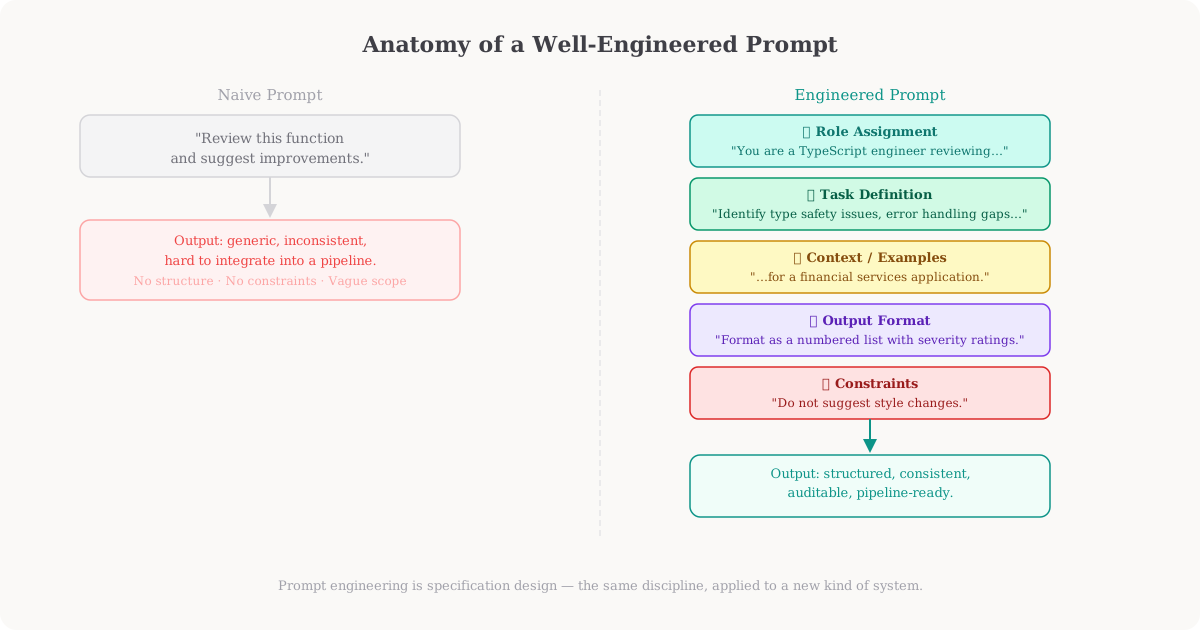
Consider the difference between these two prompts for a code review task:
Naive: "Review this function and suggest improvements."
Engineered: "You are a TypeScript engineer reviewing code for a financial services application. Review the following function and identify: (1) any type safety issues, (2) error handling gaps, (3) performance concerns for inputs larger than 10,000 records. Format your response as a numbered list with a severity rating of high, medium, or low for each issue. Do not suggest style changes."
The second prompt does not just produce a better answer. It produces a consistent, structured, auditable answer that can be integrated into an automated code review pipeline. That is the difference between a one-off experiment and a production-grade system.
Why This Skill Has a Long Half-Life
The most common objection to investing in prompt engineering is that it will be automated away — that future models will be so capable they will not need careful prompting. I think this gets the trajectory backwards.
As models become more capable, the systems built on top of them become more complex. More complex systems require more precise communication. The expectations for reliability and consistency increase. The cost of a poorly specified prompt in a system that processes a million requests per day is vastly higher than in a system that processes ten.
Moreover, the engineers who understand how to prompt effectively will be the ones who understand how to build the automated systems that generate and refine prompts. You cannot automate what you do not understand.
The Investment Worth Making
Prompt engineering is not a replacement for deep technical skills. It is an amplifier of them. A domain expert who understands how to communicate their expertise to a model — precisely, reliably, and at scale — is extraordinarily valuable.
The engineers who will define the next generation of AI products are not those who treat LLMs as black boxes to be queried with vague instructions and hopeful optimism. They are the ones who approach the model as a programmable system with known properties, documented patterns, and testable behaviour.
The skill is available to learn today. The competitive advantage for those who invest in it is real and measurable. The question is not whether prompt engineering matters — it is whether you will take it seriously before it becomes table stakes.