
The Civilisational Impact of AI: How Artificial Intelligence Will Reshape Every Industry, Institution, and Human Experience
Every few generations, a technology emerges that does not merely improve existing systems but fundamentally rewrites the rules of human civilisation. Fire enabled survival. The printing press democratised knowledge. Electricity restructured the economy. The internet collapsed geography. Artificial intelligence is next — and its scope may surpass them all.
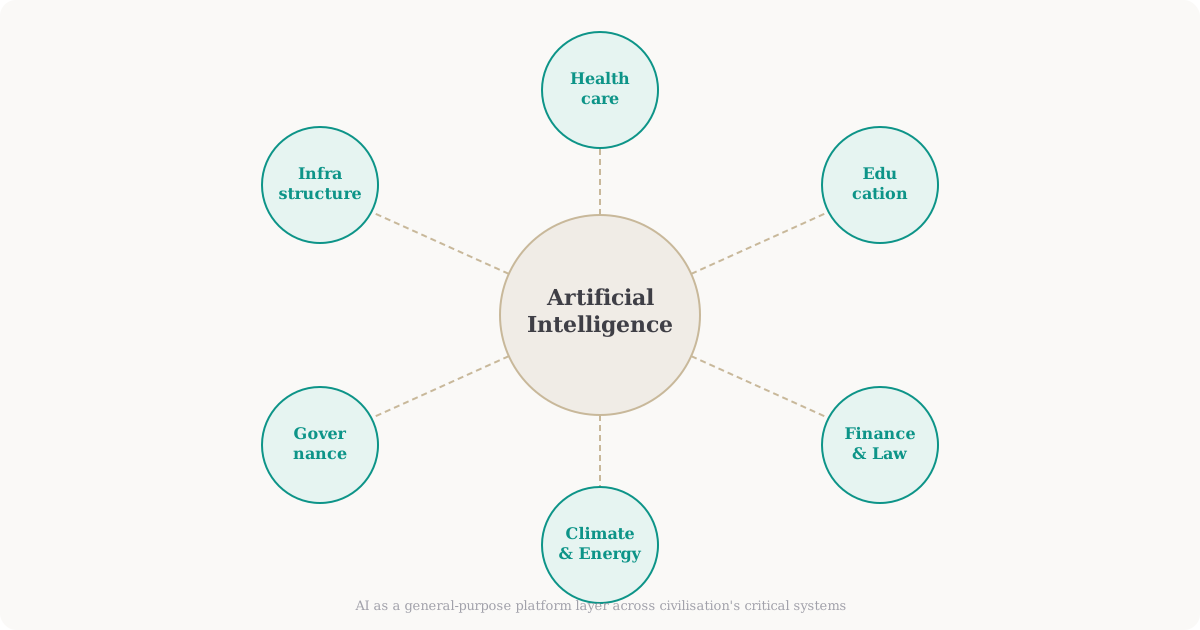
What makes AI different from previous technological revolutions is not just its raw capability, but its generality. A power grid can light a factory but cannot diagnose a patient. A search engine can surface information but cannot reason over it. AI, by contrast, is a general-purpose cognitive layer that can be applied to almost any domain where intelligence has historically been required. That is not an incremental improvement — it is a platform shift.
Rewriting Healthcare From the Ground Up
Perhaps no sector illustrates AI's civilisational potential more vividly than healthcare. DeepMind's AlphaFold solved a 50-year-old grand challenge in biology — predicting the 3D structure of proteins — in a matter of months. The implications are staggering: drug discovery, which once took decades and billions of pounds, can now be accelerated by orders of magnitude. Diseases that have resisted treatment because their underlying protein mechanisms were poorly understood are suddenly tractable.
Beyond drug discovery, AI diagnostic systems are now matching — and in some cases surpassing — specialist physicians at identifying cancers from imaging data. AI models are predicting patient deterioration hours before clinical signs appear, giving clinicians a window to intervene. In resource-constrained healthcare systems, this is not just efficiency — it is lives saved that would otherwise have been lost.
The deeper transformation is one of access. For much of human history, the quality of your healthcare has been determined by your postcode. AI has the potential to decouple expertise from geography, putting diagnostic capability that once existed only in elite hospitals into the hands of a community health worker with a smartphone.
Transforming Education and the Nature of Learning
Education has remained structurally unchanged for centuries: a teacher, a class, a fixed curriculum, a standardised exam. AI breaks every one of those constraints.
Personalised tutoring systems can now adapt in real time to a learner's pace, identify conceptual gaps, and adjust the difficulty and framing of problems accordingly. The evidence from early deployments is striking — students learning with AI tutors in controlled studies have shown performance gains equivalent to moving from average to top-quartile outcomes. Historically, that level of personalised instruction required a private tutor — a privilege available only to the wealthy few.
The implications for developing economies are profound. A child in Lagos or Nairobi with a tablet and an internet connection can now access a quality of educational support that previously required expensive schooling. AI does not guarantee educational equity, but it removes one of the most persistent structural barriers to it.
Governance, Justice, and the Dangers of Unexamined Deployment
Not all of AI's civilisational impact is benign, and it is dishonest to pretend otherwise. The same systems that can personalise medicine can also be used to personalise manipulation. The same pattern-recognition capabilities that identify tumours can identify dissidents.
In the justice system, AI risk-assessment tools are already being used to inform bail and sentencing decisions in several jurisdictions. The core concern is not that these systems are automated — it is that they encode historical patterns of bias into decisions that affect human freedom. A system trained on data from a structurally unequal society will reproduce that inequality with algorithmic precision and a veneer of objectivity.
Governance of AI is not a technical problem. It is a political, ethical, and institutional one. The engineers building these systems have a responsibility that extends beyond correctness and performance. The question "does this system work?" must always be accompanied by "does this system cause harm, and to whom?"
Climate, Infrastructure, and the Optimisation of Civilisation
AI is already being deployed to address one of the defining challenges of our era: climate change. DeepMind's work with Google's data centres used AI to reduce cooling energy consumption by 40%. Similar optimisation is being applied to electrical grids, logistics networks, and agricultural supply chains — systems that, taken together, account for a substantial share of global carbon emissions.
In climate science, AI models are dramatically accelerating our ability to simulate and predict complex systems — from hurricane trajectories to the behaviour of ice sheets. The speed at which we can iterate on climate models has implications not just for scientific understanding but for policy decisions that will shape the planet for centuries.
What This Means for Engineers
For those of us who build software, AI's civilisational moment is also a professional reckoning. The systems shaping healthcare, justice, education, and climate are being written by people like us. The decisions embedded in those systems — which data to use, which outcomes to optimise for, which edge cases to handle, and which to ignore — are engineering decisions with civilisational consequences.
This demands a broader conception of what it means to be a software engineer. Technical correctness is necessary but not sufficient. The engineers who will matter most in the AI era are those who can reason across domains, engage with ethical complexity, and build systems that earn — rather than simply assume — the trust placed in them.
The civilisational shift is already underway. The question is not whether AI will reshape the world, but whether those building it will do so with the care and intentionality that the moment demands.