
AI Will Not Replace Software Engineers — At Least Not Yet: The Case for Human–AI Collaboration in Software Development
Every time a powerful new tool enters the software industry, someone declares that engineers are finished. CASE tools in the 1980s were supposed to make programmers obsolete. Fourth-generation languages in the 1990s were going to let business analysts write their own software. No-code platforms were going to replace developers entirely. Each prediction shared the same flaw: it confused automating parts of the job with automating the job.
We are in the midst of that same conversation again, this time about large language models. And once again, the prediction is both correct and wrong at the same time — correct that AI will change what software engineers do, wrong about the direction of that change.
What AI Can Actually Do
To have an honest conversation about this, we need to be precise about AI's genuine capabilities rather than dismissing them or overstating them.
Tools like GitHub Copilot, Claude, and Cursor are genuinely impressive. They can generate syntactically correct, idiomatic code for well-defined tasks. They can explain unfamiliar codebases, suggest refactors, write tests, and translate code between languages. For common patterns — CRUD endpoints, form validation, data transformation — they produce working first drafts at a speed that no human can match. A competent engineer using these tools well is meaningfully more productive than the same engineer without them.
This is not hype. I use these tools daily, and the productivity difference is real. Accepting that is not a concession — it is the starting point for an honest analysis of what comes next.
The Hard Limits
The claim that AI will replace software engineers assumes that the hardest part of the job is writing code. It is not.
Writing code is the implementation of a decision. The hard part is making the right decision in the first place — and that requires a kind of reasoning that current AI systems cannot reliably perform.
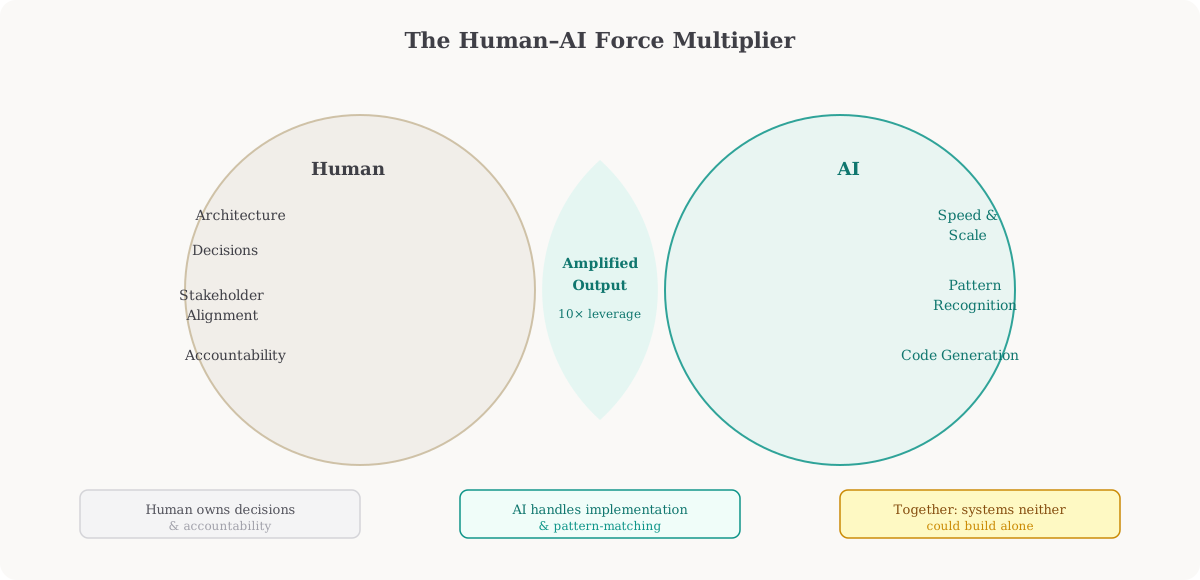
Architectural reasoning involves understanding a system's current state, its likely future states, the constraints of the organisation building it, and the trade-offs between competing approaches. It requires holding many variables in tension simultaneously and choosing the option that best survives contact with reality. When I decide whether to introduce an event-driven architecture to a system, I am not just evaluating technical correctness. I am evaluating team familiarity, operational complexity, deployment infrastructure, business timelines, and the likelihood that requirements will change. No current AI system can own that decision, because owning a decision means being accountable for its consequences.
Stakeholder alignment is one of the most underappreciated skills in software engineering, and it is entirely human. Translating ambiguous business requirements into precise technical specifications requires dialogue, negotiation, and the ability to recognise when a stakeholder does not yet know what they want. It requires building trust over time and reading the political dynamics of an organisation. These are not problems that can be prompted away.
Novel failure modes are by definition outside the training distribution of any AI system. When a production system behaves unexpectedly under real-world load — when the bug is an emergent property of the interaction between three services, a third-party API's undocumented behaviour, and a race condition that only manifests under specific network conditions — the engineer debugging it is doing something that no current AI can replicate: reasoning under genuine uncertainty about a system whose behaviour was not anticipated.
Ethical accountability cannot be delegated to a model. When a system you built causes harm — through a bias in its outputs, a security vulnerability, or an unintended consequence — the responsibility belongs to the humans who designed and deployed it. AI can assist in identifying risks, but it cannot carry responsibility. That remains irreducibly human.
The Redefinition of the 10x Engineer
The "10x engineer" is a concept that has always been somewhat mythologised — the lone genius who produces ten times what an average engineer produces through sheer individual brilliance. That archetype is being quietly retired, and something more interesting is replacing it.
The most impactful engineers I observe today are not those who write the most code. They are those who most effectively orchestrate a combination of human judgment, team collaboration, and AI tooling to produce outcomes that none of those components could achieve alone. The leverage available to an engineer who deeply understands how to work with AI tools — who knows when to trust them, when to verify them, and when to override them — is genuinely extraordinary.
This is a different kind of 10x. It is not about individual output measured in lines of code. It is about the quality of the decisions made and the speed at which good systems get shipped. It favours engineers who are curious, adaptable, and comfortable working in close collaboration with tools that are powerful but imperfect.
A Practical Framework for Today
If AI is a force multiplier, then the question is not "will AI replace me?" but "am I positioned to be multiplied by it?"
That means investing in the skills that AI amplifies rather than the skills it replicates. Writing boilerplate code faster than a model is a losing proposition. Understanding system design deeply enough to evaluate AI-generated architecture suggestions is a winning one. Memorising API documentation is less valuable than knowing which questions to ask and how to verify the answers.
It means treating AI-generated code with the same scrutiny you would apply to code from a junior engineer — not dismissing it, but not shipping it unreviewed. The model does not have context about your system that it has not been given. It does not know which invariants must hold. It does not know about the outage that happened six months ago because of exactly this pattern. You do.
It means staying genuinely curious about the frontier. The capabilities of these models are improving rapidly. An honest assessment of what AI cannot do today should be held with some humility, because what it cannot do today may be different from what it cannot do in two years.
The Partnership Is the Point
The engineers who will struggle in the AI era are those who either refuse to engage with these tools or who abdicate their judgment to them. Both responses misunderstand the nature of the opportunity.
The engineers who will thrive are those who see AI for what it is: a remarkably capable collaborator with genuine strengths and well-defined limitations. A collaborator that removes the tedium of implementation, freeing up cognitive bandwidth for the work that actually requires human judgment — design, decision-making, accountability, and the relentless pursuit of systems that are not just functional, but good.
The future of software engineering is not a competition. It is a partnership. And the engineers who embrace that partnership, on their own terms, with their judgment intact, will build things that neither humans nor AI could build alone.